





 Contact us
Contact us
Contact us
How long does local SEO take for a childcare centre? If you’re paying for SEO, you shouldn’t have to wait months before anyone can show you whether the work is moving in the right direction.
Google gives businesses no fixed ranking deadline. Its SEO Starter Guide says some changes can show within hours, while others take several months. Google also recommends allowing at least a few weeks before judging the effect of website SEO work.
Local visibility has another layer. Google says local rankings depend mainly on relevance, distance and prominence.
That means a credible SEO plan needs to separate three things: what your team can fix now, what Google still needs to process, and what you need to build against competitors.
The goal isn’t a promised month. It’s measurable progress towards qualified parent enquiries, centre tours and enrolments at a cost that makes commercial sense.
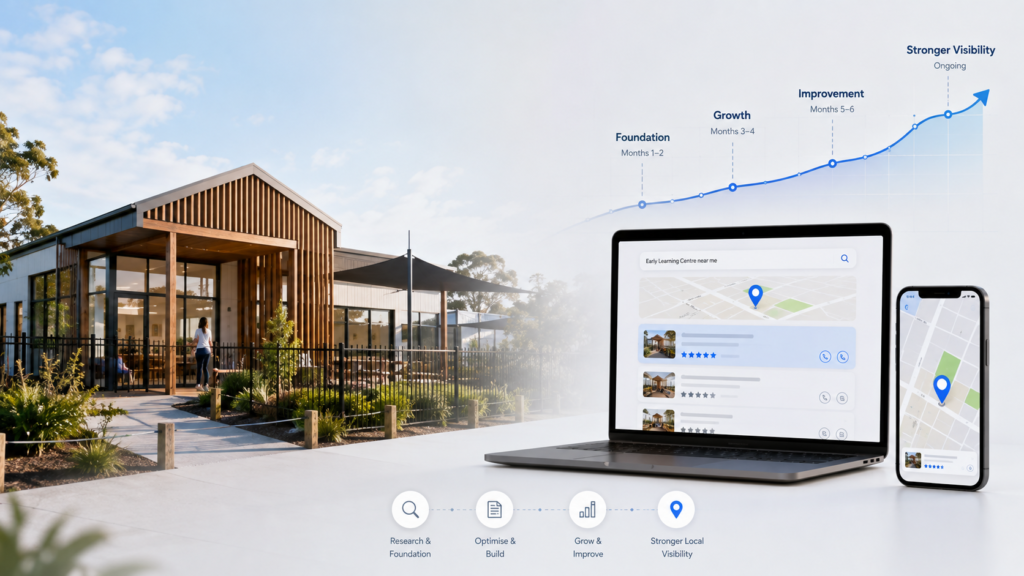
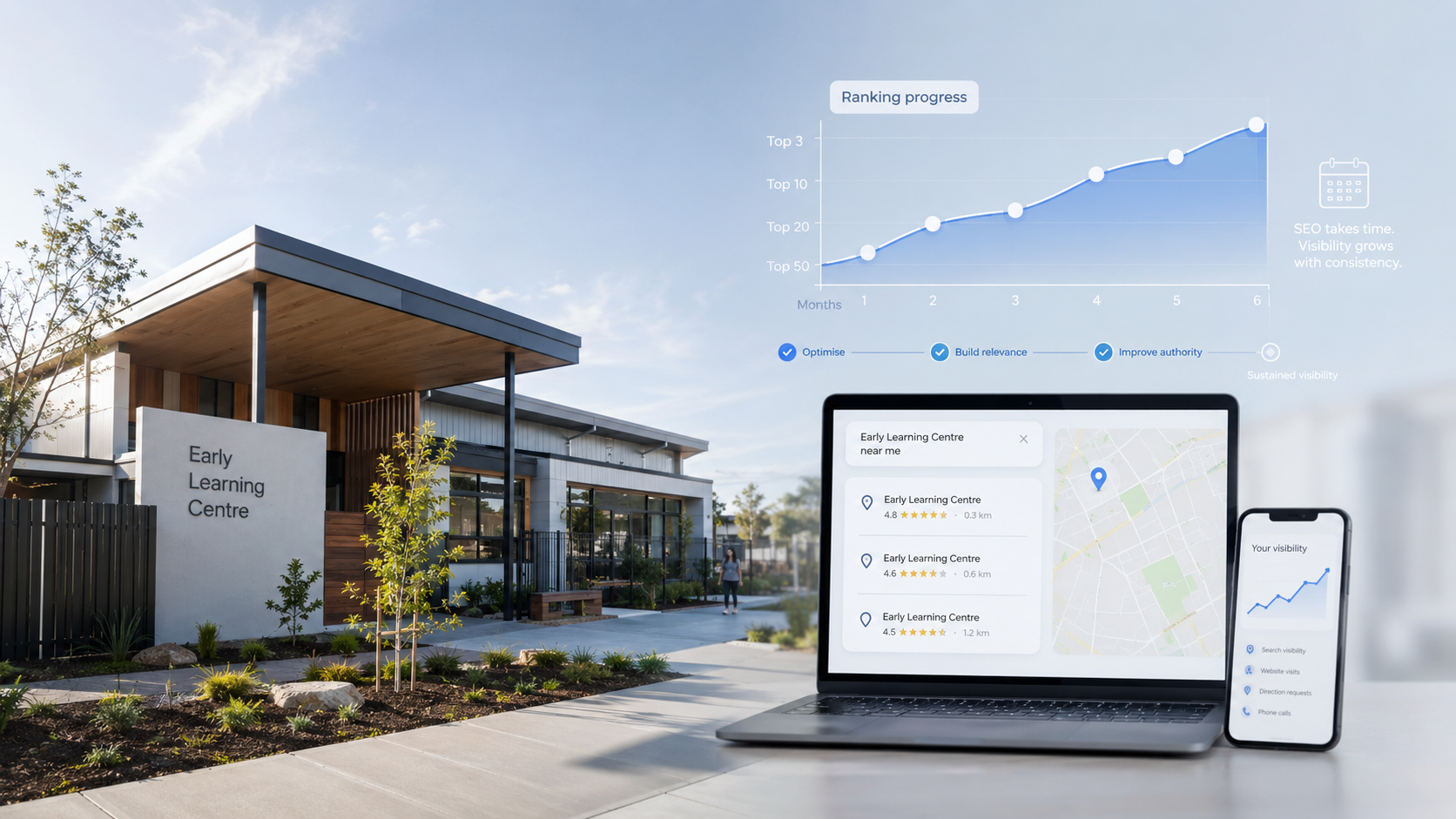
Local SEO has no fixed ranking timeline. You can improve your profile and website quickly. Google says recrawling changed pages can take days or weeks. Stronger rankings take longer when established competitors already have better reviews, content and local prominence. Your starting position determines the roadmap.
That is why a useful timeline starts with a baseline assessment, not a generic three-month or six-month promise.
The biggest mistake is treating implementation and results as the same thing.
Correcting your Google Business Profile today is an action. It doesn’t mean Google Maps rankings change tomorrow.
Your local SEO ranking timeline has three separate stages.
| Stage | What can happen | What it tells you |
|---|---|---|
| Work completed | Profile details corrected, technical issues fixed, tracking set up, priority pages improved | The planned work is being done |
| Google processing | Pages crawled and indexed, relevant search impressions change, your centre appears for more useful searches | Google is recognising the changes |
| Competitive and commercial movement | Maps and organic visibility change, enquiries and tours move, lead quality becomes clearer | The work is starting to affect business outcomes |
This framework gives you something better than a month-by-month promise. It shows what evidence should exist while you’re paying for SEO.
Some work can be done straight away.
Your team can fix inaccurate profile information, repair obvious technical problems, improve page titles, strengthen location content and configure tracking.
They can also make it easier for a parent to enquire or book a tour. More traffic won’t fix a website that loses interested parents.
These steps show the work has been done. They don’t show that rankings have improved yet.
Google decides when it revisits and reviews changed pages.
Its recrawl guidance says crawling a changed page can take from a few days to a few weeks. Repeated requests don’t make Google crawl the page faster.
Crawling, indexing and ranking are separate steps.
A page can be fixed before Google recrawls it. Even after Google processes the change, the page doesn’t automatically move to a stronger ranking position.
For broader site improvements, Google’s core update guidance says some changes can take several months to be recognised. Google also says not every website change produces a noticeable improvement in Search.
You don’t control the other childcare centres competing for the same parent searches.
Google’s local ranking guidance says relevance, distance and prominence are the main local ranking factors. Prominence is Google’s term for how established or well known a business appears. Reviews and links contribute to it.
That means some local SEO results have to build over time.
You can improve the signals Google uses. You can’t set the day your centre will become the strongest local result for a parent searching nearby.
Good local SEO starts with diagnosis.
Before changing pages or publishing content, you need to know what Google already sees and whether search is producing enquiries.
A useful baseline shows where your centre stands before work begins.
That includes:
Without that baseline, you can’t tell whether the campaign is progressing or simply producing activity.
This is the first answer to how long does SEO take for your centre. You need to know how far behind or ahead you are before setting a realistic plan.
Google can’t rank a page it can’t access or understand properly.
This stage covers indexing problems, page structure, internal links, location information and other issues that make it harder for Google to understand your site.
Fixing those problems doesn’t guarantee a ranking jump. It removes barriers that can hold the rest of the SEO work back.
Your Google Business Profile can be reviewed and corrected as soon as the work starts.
Business categories, services, opening hours, address details, contact information and photos help Google understand your centre.
Google states that complete and accurate information helps businesses appear for relevant local searches.
Profile optimisation is quick to implement. Ranking movement still depends on relevance, distance, prominence and the centres competing with you.
Your website needs to make two things clear: why your centre matches the parent’s search and what they should do next.
A thin centre page gives Google very little to work with. Stronger pages clearly explain your location, programs, enrolment process and the questions parents ask.
That also gives parents more reason to enquire.
If parents find your site but don’t enquire, rankings are no longer the only problem. A conversion-focused website has to turn that interest into an enquiry or tour request.
Two childcare centres can start SEO on the same day and face completely different jobs.
Centre A has an established website, a complete Google Business Profile, useful centre content and a steady flow of reviews. Centre B has a new website, thin location content and little local prominence.
The same SEO work doesn’t start from the same line.
A generic SEO timeline for small business ignores that difference.
An established website with useful pages already indexed gives Google more information than a new five-page site.
If Google already understands your centre, location and programs, the job is refinement and competitive improvement.
If the site is unclear or barely indexed, the job starts with fixing the foundation.
A complete profile gives Google clearer local business information.
An incomplete profile leaves basic gaps before you even compare reviews, prominence or competitors.
Profile quality doesn’t remove the other ranking factors. It gives Google better information to work with.
You cannot remove distance as a ranking factor.
Google says local results consider how far each business is from the searcher. Relevance and prominence still affect which centres Google considers the best match.
Competition changes the size of the job as well.
A centre facing well-established competitors has a bigger job. Strong competitor reviews, content and local prominence all raise the standard you need to meet.
Reviews influence both local prominence and parent confidence.
Google states that review count and positive ratings can help local rankings.
The commercial issue goes further. More Maps visibility has limited value if parents open your profile, don’t trust what they see and choose another centre.
Reviews support the search system and the conversion system.
Google uses prominence to describe how well known or established a business appears.
Its local ranking guidance points to information such as links and reviews as prominence signals.
A new centre doesn’t start with the same reviews and links as an established local operator. Those signals have to be built over time through real business activity and local visibility.
If you’re asking how long before SEO works, define what progress looks like before the final ranking result arrives.
Use a simple measurement chain:
The first four are early signs of progress. They show whether Google is processing the work and whether your search visibility is changing.
Enquiries, tours, enrolments and cost per enrolment are the commercial measures. They show whether better visibility is turning into revenue.
This is how you judge local SEO results without waiting for one keyword to reach one position.
If rankings rise but enquiries don’t, investigate the website and conversion path. If enquiries rise but tours don’t, the next bottleneck sits further down the lead system.
Hills Media’s Full Lead System connects local SEO with website conversion, ads, lead tracking, follow-up and reporting. The point is to measure the path from visibility to revenue, not stop at traffic.
“SEO takes time” is not a blank cheque.
A campaign deserves investigation when your agency can’t show what was changed, what Google has processed or what needs to happen next.
Warning signs include:
Three months by itself is not a stop signal.
But three months of invoices with no clear record of work, no useful measurement and no explanation of the problem is a commercial concern.
You should know what has changed, what hasn’t, and what happens next.
Local SEO isn’t an emergency switch.
If you need enrolment enquiries now, relying on organic visibility alone is the wrong short-term plan.
Paid search puts your centre in front of relevant searches while the SEO work builds. It also gives you faster data on enquiry volume, lead quality and cost per lead.
That doesn’t mean spending blindly on ads.
Sending paid traffic to a weak website with poor tracking wastes budget. Paid and organic traffic both need a clear path from search to enquiry and tour booking.
For childcare operators, that is why local SEO works best inside a wider childcare marketing system rather than as an isolated ranking project.
The credible answer to “how long for my centre?” starts with your current position.
Hills Media looks at the wider lead system before recommending more SEO. Your website conversion rate, cost per lead, follow-up and lead tracking all affect whether more search visibility creates revenue.
If local visibility is the bottleneck, you need a clear starting point and an order for what gets fixed first.
If conversion or follow-up is the bigger problem, sending more organic traffic to the same system wastes time and budget.
You should be able to see how search activity connects to enquiries, tours and enrolments. If you can’t, the problem isn’t just rankings.
There is no fixed period. Google’s SEO guidance says some changes can show within hours, while others take several months. It recommends allowing at least a few weeks before judging website changes. Look for progress in stages: completed work, Google processing, changing visibility, then enquiries and enrolments.
Your Google Business Profile can be corrected immediately, but Google doesn’t publish a deadline for stronger Maps rankings. Local results depend on relevance, distance and prominence. Track whether your centre appears for more relevant searches, gains local visibility and receives more useful profile actions.
Because every centre starts from a different position. Website quality, Google Business Profile completeness, location, competition, reviews, content and local prominence all change the job. A new centre starts with different challenges from an established centre with indexed pages, reviews and stronger local signals.
It produces some of the fastest changes to make because profile information can be corrected directly. That doesn’t mean rankings change straight away. Google still assesses relevance, distance and prominence when ordering local results. Improve the profile, then track how your visibility and profile actions change.
Google says search changes can take from a few hours to several months to show an effect. Its recrawl guidance says crawling a changed page can take from a few days to a few weeks. Crawling, indexing and ranking are separate steps. A recrawl means Google revisited the page. It doesn’t mean the ranking will rise immediately.
A new centre can build the right foundation immediately, including its website, Google Business Profile, local content and tracking. It still starts with fewer reviews, links and local signals than established competitors. Build those signals and measure progress instead of relying on a promised ranking date.
Track the full path from Google visibility to enrolment. Check indexing, relevant search impressions, Maps visibility, website visits, profile actions, enquiries, tour bookings, conversion rate and cost per lead. Early search signals show whether the work is being recognised. Enquiries and enrolments show whether it is creating business value.
No. Three months by itself is not a decision rule. Review what was changed, whether Google processed it, whether relevant visibility moved and whether enquiries changed. If nothing measurable is moving and your agency can’t explain why or adjust the plan, investigate before paying for more of the same.
You don’t need another generic timeline. You need to know what is holding back enquiries and what should be fixed first.
Book a Lead System Audit with Hills Media to identify the bottleneck before you commit more budget to SEO.