




 Contact us
Contact us
Contact us
Solar leads get expensive when the system leaks.
Not because demand is weak. Australian households and small businesses are still comparing solar, batteries and energy upgrades. The problem sits between the click and the booked quote.
A strong solar marketing agency does more than run ads. It fixes the whole enquiry system. That means the targeting, offer, landing page, form, CRM, follow-up and reporting all work together.
If your cost per lead keeps climbing, don’t start by increasing the budget. Start by finding the waste.
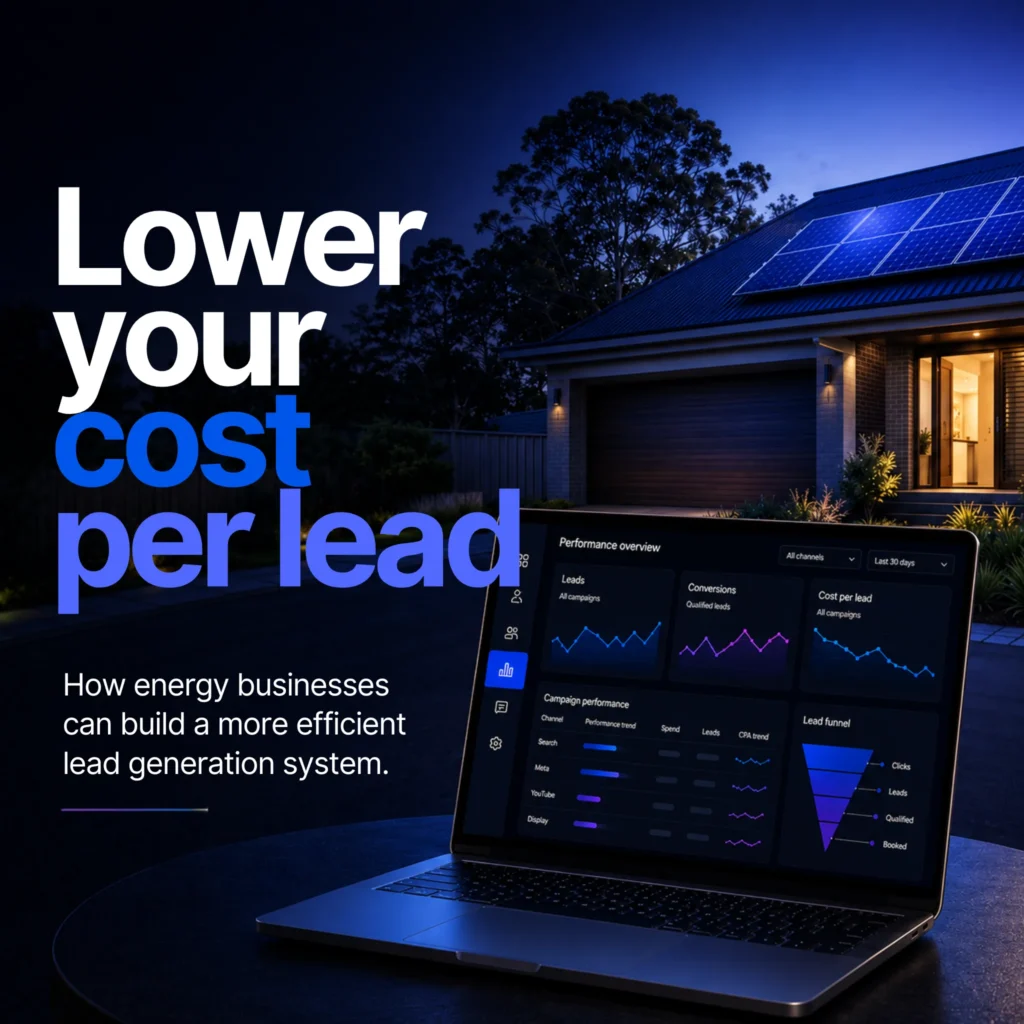
Most solar businesses don’t have a lead volume problem.
They have a lead quality problem.
They pay for clicks from people who aren’t ready. They send traffic to vague service pages. They count every form fill as a win, even when the lead is a renter, outside the service area or just chasing a rebate number.
Then sales gets blamed.
That’s the wrong diagnosis.
Cost per lead rises when your marketing attracts the wrong people, loses the right people and gives you poor data. You can’t optimise what you can’t see.
The fix is direct: tighten the full journey from search to booked quote.
A solar marketing agency builds and improves the system that turns paid and organic traffic into qualified solar, battery and energy-efficiency enquiries.
The work covers:
The goal is not more leads at any cost.
The goal is more qualified enquiries at a cost your margins can handle.
Google Ads works well for solar because it captures people with active intent.
Someone searching for “solar battery installer Melbourne” is further along than someone searching “how does solar work”. Treating those searches the same burns money.
Your campaigns need to separate buyers by intent, product and location.
High-intent searches deserve stronger budgets and tighter landing pages. Early research searches need a different offer or a lower bid. Poor-fit traffic needs to be blocked with negative keywords.
For Melbourne solar and energy businesses, this is where local Google Ads support matters. You need campaigns built around service areas, suburb demand, rebate language and sales capacity.
Track the numbers that affect revenue:
Clicks don’t pay wages. Booked quotes and installs do.
If your ads bring traffic but enquiries stay weak, your landing page is the bottleneck.
Most solar pages ask buyers to work too hard. They talk about quality, service and sustainability. They don’t answer the buying questions fast enough.
Your page needs to show:
The form also matters.
A short form gets more leads. A smarter form gets better leads.
Ask for postcode, property ownership, property type, bill range and product interest when your sales team needs stronger qualification. Use a shorter form when enquiry volume is low and qualify through fast follow-up.
That is practical conversion optimisation. Not button colours. Not vague design tweaks. Better conversion rate means more of your paid visitors turn into qualified sales conversations.
A cheap lead is not cheap if it never becomes a booked quote.
Many solar businesses know their cost per lead. They don’t know which leads are worth buying.
That gap costs money.
Your reporting needs to follow the lead past the form submission. At minimum, track:
Ad platforms count conversions. Your sales team counts real opportunities.
You need both views in one system.
A lead generation agency that only reports impressions, clicks and form fills is not giving you enough data to scale.
Solar and battery buyers compare providers.
They fill in more than one form. They speak to the business that responds first and explains the next step clearly.
Slow follow-up turns paid leads into competitor revenue.
Your process should respond straight away. That doesn’t mean your sales team needs to manually chase every enquiry the second it lands.
Use automation to protect the opportunity.
A simple follow-up system can send:
This is basic revenue protection.
If you pay for leads and let them sit in an inbox, your real cost per lead is higher than your report shows.
Not every solar buyer wants the same next step.
Some want a quote now. Some want to check battery eligibility. Some want to understand payback. Some want to compare solar and battery options before they speak to sales.
One generic “get a quote” page misses too many buyers.
Better campaign offers include:
High-intent search traffic can go straight to a quote or assessment page. Earlier-stage traffic needs education and follow-up. Retargeting brings comparison buyers back when they are ready.
That reduces waste because each buyer sees the next step that fits their stage.
Solar and battery incentives drive enquiry volume, but sloppy claims damage trust.
Name the schemes accurately. Don’t imply every buyer qualifies.
Common Australian schemes and incentives include the Small-scale Renewable Energy Scheme (SRES), small-scale technology certificates (STCs), the Australian Government Cheaper Home Batteries Program and state programs such as Victoria’s Solar Homes Program.
Some businesses also need state-specific pages for schemes such as WA battery rebates or NSW battery incentives when those offers apply.
Your copy should explain:
Avoid vague claims like “save thousands” unless you explain the basis.
Good buyers don’t need hype. They need clarity
Don’t choose an agency based on lead volume promises.
Ask sharper questions.
You need reporting that separates raw leads from qualified enquiries, booked quotes and sales.
Solar and battery buyers compare products, incentives, installers and finance. Your funnel needs to reflect that.
Sending paid traffic to a weak service page wastes budget. Campaigns need dedicated conversion pages.
If leads are not tracked through the sales process, the agency can’t optimise for revenue.
Lead speed, missed-call handling and nurture sequences directly affect conversion rate.
Your business should own the ad accounts, website, CRM data, landing pages and reporting assets.
Hills Media builds customer acquisition systems for Australian solar, battery, renewable energy and energy-efficiency businesses.
The work starts with diagnosis.
We look at where your current system leaks money:
Then we build around the commercial target.
For some businesses, that means a Conversion Website with stronger service pages and landing pages.
For others, it means a Full Lead System covering ads, tracking, CRM and automation.
For established businesses ready to scale, Growth Accelerator focuses on optimisation, attribution and performance improvement.
You can also see Hills Media’s dedicated Eco / Energy Marketing Systems page.
The number in your ad account is not the full story.
A $70 lead that never answers the phone is expensive. A $220 lead that becomes a booked quote and closed install is cheap.
So the better question is not “How do we get cheaper leads?”
The better question is: “How do we get more profitable enquiries from the same or lower spend?”
That answer sits in the system.
Fix the targeting. Fix the landing page. Fix the tracking. Fix the follow-up.
Then scale what works.
Solar companies get better quality leads by tightening targeting, using dedicated landing pages, qualifying enquiries before sales contact and tracking booked quotes. The best systems filter by location, property type, ownership, product interest and buyer intent.
Solar cost per lead increases when ad competition rises, targeting is too broad, landing pages convert poorly or follow-up is slow. It also rises when campaigns optimise for raw form fills instead of qualified enquiries and booked quotes.
Buying leads gives quick volume, but quality and exclusivity vary. Running your own ads gives more control over targeting, landing pages, lead data, follow-up and long-term cost per acquisition. Many established installers move toward owned acquisition systems once they have sales capacity.
A good cost per lead depends on your product mix, location, margins, close rate and sales capacity. Solar panel, battery and commercial energy leads should not be judged by the same benchmark. Cost per booked quote and cost per sale give a cleaner view than raw CPL.
Follow up within minutes. Solar and battery buyers compare providers, so response speed affects booked-quote rates. Use instant SMS, email confirmation, call tracking, missed-call text and CRM tasks to stop paid enquiries from going cold.
A solar landing page should include service areas, product options, eligibility guidance, trust proof, a clear quote process, strong calls to action and a form that captures key qualification data. It should be built for enquiries, not just information.
If your solar or energy business is spending on ads, referrals or lead providers and the numbers don’t make sense, start with diagnosis.